A weekend of Vilnius street art: the self-guided tour
Vilnius has never had an official street art programme — the murals here happened through decades of informal accumulation, neighbourhood identity-building, and the occasional commission from a building owner who wanted something different on their wall. That absence of institutional curation gives the scene a heterogeneous, organic character that feels more honest than the curated “street art districts” you find in cities where tourism agencies got involved.
| Where | Užupis (dense), Šnipiškės, Naujininkai, old town underpasses |
| Cost | Free — self-guided, no tickets needed |
| Time needed | Half a day for Užupis alone, a full day for all districts |
| Best time | Early morning (before 9am) for the Constitution wall without crowds |
| Bring | A phone camera; a wide lens helps for building-height murals |
The concentration is highest in Užupis, the bohemian district that declared independence as a republic in 1997, but the rest of the scene is scattered across Naujininkai, Šnipiškės, Žvėrynas, and the outer edges of the old town. A good weekend walk will cover most of it.
Užupis: where the scene began
Užupis — the name means “across the river” in Lithuanian, referring to its position over the Vilnelė — was a rundown neighbourhood of crumbling pre-war buildings and squatted workshops when artists started moving in during the 1990s. It’s gentrified considerably since then, but it retains the studios, the independent venues, and the density of public art that marks a neighbourhood that took its identity seriously.
The angel at the bridge: The bronze angel at the main Užupis bridge is the district’s symbol and the most-photographed piece of public sculpture in the area. Unveiled in 2002, it sits atop a column at eye level with the bridge railing — unusual placement that makes it feel more present than a figure on a high plinth. The surrounding metalwork and cobblestones have been layered with stickers and minor grafitti over time, giving the base a patina of accumulation.
The Constitution wall on Paupio Street: The Republic of Užupis has a constitution — a list of 41 articles that includes statements like “Everyone has the right to be happy” and “A dog has the right to be a dog.” The text is displayed on polished metal plaques along Paupio Street in dozens of languages: Lithuanian, English, French, Spanish, Arabic, Hebrew, Japanese, and more. Walk the length of the wall and read several; the tone shifts between genuine sentiment, gentle absurdism, and what might be read as political critique. It’s one of the most thoughtful pieces of public text art in any European city.
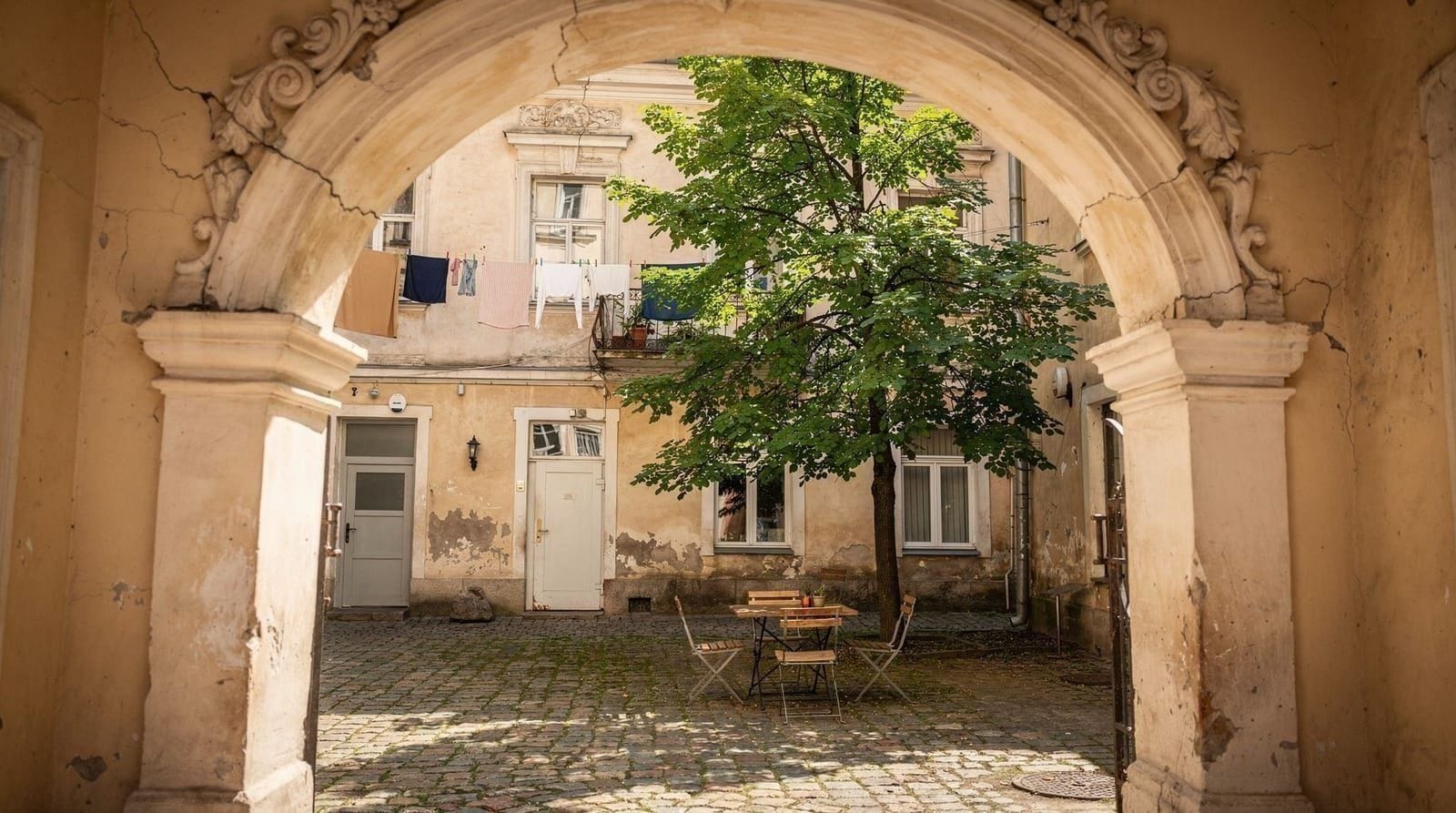
Courtyards and gates: The Užupis galleries and studios are partly outdoors — courtyard installations, gate murals, door art. The culture here encourages exploration of semi-private spaces; if a gate is open, you can generally walk in. You’ll find ceramics mounted on walls, mosaics, and painted surfaces in states of various decay and renewal.
The Joneliu Street mural sequence: Along the back streets of Užupis (particularly around Jonelių g. and Polocko g.), a sequence of building-height murals has accumulated over the past decade. Artists from Lithuania and internationally have contributed. The styles are heterogeneous — some figurative, some abstract, some political. This area changes more frequently than the more canonical Užupis pieces.
Beyond Užupis: the wider city
Naujininkai district: South of the railway station, the Naujininkai neighbourhood has a lower-income, more diverse population and a rawer mural scene. The pieces here are less polished than the Užupis commissions and more interesting for it — tags, throw-ups, wheat-paste posters, and the occasional large-format figurative work share wall space with political graffiti in Lithuanian and Russian. Not a tourist route; worth an hour if you’re interested in the less curated end of street art.
Šnipiškės (behind the National Gallery of Art): The Šnipiškės district across the Neris River from the old town has seen significant residential development, but the older low-rise streets behind the National Gallery have wall space that artists have colonised. Several large murals depicting Lithuanian folk motifs in contemporary graphic styles appeared in the early 2020s and are still largely intact.
Gedimino Prospektas underpasses: The pedestrian underpasses along the main avenue are not glamorous, but several have been used for legal mural projects and the quality varies from student-project level to genuinely accomplished. Check the underpass at Gedimino/Pylimo as a starting point.
The Bernardinai Garden walls: The garden itself is well-maintained public green space, but its perimeter walls on the Maironio g. side have accumulated a dense layer of work over the years. The proximity to St Anne’s Church and the art school (Vilnius Academy of Arts is nearby) means this is a contested surface — regular whitewashing followed by rapid recolonisation. If you want more green space after the walls, the Vilnius parks and green spaces guide covers the Bernardinai Garden itself and the other pockets worth a slow half hour.
Neighbourhoods compared
| Neighbourhood | Density | Best for | Time needed |
|---|---|---|---|
| Užupis | Very high | The Constitution wall, the angel, courtyard art | 2-3 hours |
| Šnipiškės | Medium | Folk-motif murals, quieter streets | 1 hour |
| Naujininkai | Low, rawer | Unpolished tags and political graffiti | 1 hour, not a tourist route |
| Old Town underpasses | Low | A quick add-on between other sights | 15-20 minutes |
What makes Vilnius street art distinct
Lithuanian street art has a relationship with folk motifs and national symbols that you don’t see in, say, Berlin or Amsterdam. The saulutė (sun cross), the Columns of Gediminas, and stylised representations of Lithuanian folk textiles appear frequently in the larger commissioned works, integrated into contemporary graphic languages that don’t feel nostalgic or kitschy. The Vilnius legends and myths guide covers where several of these recurring symbols come from, which adds context once you start noticing them repeat across different murals.
How street art sits against the city’s baroque core
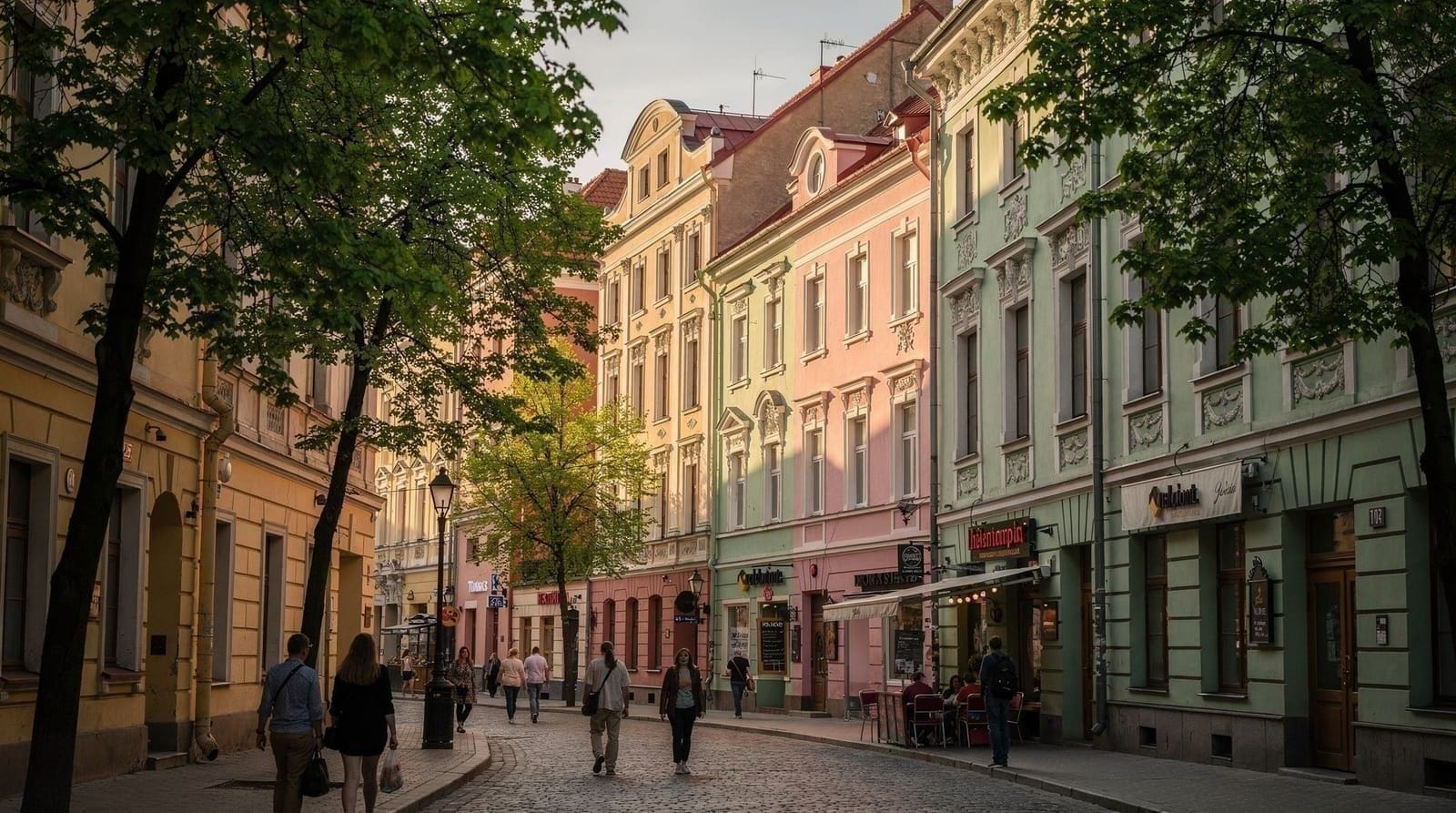
Part of what makes Vilnius murals read differently from other cities is the contrast: Old Town is one of the best-preserved baroque city centres in Europe, and the street art scene grew up in the gaps around it rather than replacing anything. Walking from the baroque churches and courtyards of the old town straight into a Užupis courtyard covered in contemporary murals is a genuine tonal shift, and it’s part of what makes a weekend combining both worthwhile rather than picking one register for the whole visit.
There’s also a political dimension that reflects the country’s recent history. Works referencing Soviet occupation, the 1991 independence defence, and the ongoing war in Ukraine (since 2022) appear alongside more purely aesthetic murals. Some pieces are temporary; others are maintained by building owners who understand their value to the neighbourhood’s identity.
The Vilnius Academy of Arts connection
The concentration of public art in Vilnius is partly explained by the density of art education here. The Vilnius Academy of Arts (Vilniaus Dailės Akademija) on Maironio g. is one of the most significant art schools in the Baltic states, and its graduates have consistently engaged with public and urban space as a field of practice. Several of the more technically accomplished large-format murals in Užupis and Šnipiškės were created by students or recent graduates; some were commissions, others weren’t.
The Academy has an exhibition space on Maironio g. that occasionally shows student work engaging with street art and public space. These shows are intermittent and not well-advertised; checking their Facebook page or the Vilnius events calendar when you arrive is the most reliable method.
The relationship between the Academy and the city’s street art scene is not purely supportive — there are debates in Vilnius, as in every city, about what counts as legitimate public art and what constitutes vandalism. These debates are healthy and reflect a city taking its public space seriously rather than ignoring it.
Seasonal considerations
Street art photography and walking works differently across Vilnius’s seasons:
Summer (June–August): Longest light, most comfortable walking, but also the most tourist volume on the Užupis main streets. Arrive before 9 am to photograph the Constitution wall and the angel area without crowds. Summer is also when the most new work appears — artists work in warm weather.
Autumn (September–October): Excellent for photography — cooler light, fewer tourists, and deciduous trees around the Bernardinai Garden walls showing colour. Many of the summer’s new pieces are still fresh.
Winter: Cold but photogenic. Snow on the cobblestones and frost on murals creates different visual material. Fewer visitors; fewer cafes open; more contemplative atmosphere. The Užupis galleries that double as studios are sometimes more accessible in winter when artists are inside working.
Spring (March–May): The Kaziukas Fair in early March brings temporary installations and folk art around Cathedral Square. A different visual register — craft, folk motifs, seasonal flowers — but worth mapping alongside the more permanent street art scene.
Practical self-guided walk
Morning (3 hours): Start at the Užupis bridge, walk the Constitution wall, explore Užupio g. north and the courtyards off it, then loop back through Jonelių g. and Polocko g. before crossing back into the old town.
Afternoon (2 hours): Cross the Neris River via the Mindaugas Bridge to Šnipiškės, walk the back streets of the gallery neighbourhood, then return via the Gedimino underpass sequence.
Maps: Google Maps satellite view is surprisingly useful for identifying large-format murals you can see from above. The Vilnius tourism website has periodically published self-guided art walk maps, though these date quickly as the scene changes.
The Vilnius hidden gems guide covers some of the architectural history that provides context for the art, and the Užupis guide covers the district’s origins and independent republic politics in more detail. If you’re building a wider photo list for the trip, the Vilnius Instagram spots guide and the Vilnius hidden gems blog post both overlap usefully with this walk.
Private alternative Vilnius bike tour — covers Užupis and the districts beyond it that this walk describesFrequently asked questions about Vilnius street art
Is street art legal in Vilnius?
Street art occupies the same ambiguous legal space it does in most European cities. Commissioned murals on private buildings are legal. Tags and unsanctioned work are technically illegal but widely tolerated in certain areas. Užupis has an informal culture of accepting unsanctioned public art.
Does the street art change frequently?
Yes — particularly the lower-profile pieces. The major commissioned murals and the Užupis constitutional plaques are relatively permanent, but the general scene evolves. What’s there in June may not be there in October.
Is there a street art tour available?
Some private walking tour operators offer Vilnius art walks. A dedicated street art guide is less common than in larger cities — many visitors do it independently using this kind of guide.
Can you visit Užupis on foot from the old town?
Yes — it’s a 5-minute walk from Pilies Street across the Užupis bridge. It’s a distinct neighbourhood character from the tourist-heavy old town core.
Are there any galleries showing urban art in Vilnius?
Several small galleries in Užupis show contemporary art that overlaps with the street art sensibility. The Vartai Gallery and the Contemporary Art Centre (CAC) on Vokiečių g. 2 show work that contextualises the street scene.
How long does the full self-guided street art walk take?
Realistically a full day if you want to cover Užupis, Šnipiškės and the old town underpasses without rushing — a half day covers Užupis alone comfortably. Naujininkai adds another hour and is optional.
Is Vilnius street art better than Riga’s or Tallinn’s?
Different rather than better. Vilnius’s scene is denser and more concentrated around Užupis’s specific bohemian history; Riga and Tallinn have their own, smaller pockets. If street art specifically is the draw, Vilnius rewards the most walking time of the three Baltic capitals.